South Yorkshire Times, December 8th 1933
Queer “Fish”
Sixty Years Of Canal Service
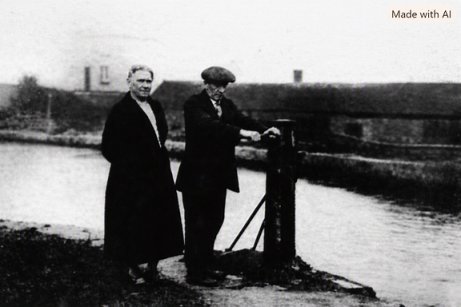
Under the shadow of a canal bridge at Wombwell stands a little cottage occupied by Mr. and Mrs. Frank Westfield who, if God spares them, will celebrate their golden wedding anniversary next year. Mr. Westfield has been on the staff of the South Yorkshire Navigation Company for sixty years! A native of Lincolnshire, Mr. Westfield began to work for the company (then the River Don Navigation Company) when he was thirteen, as an apprentice joiner. He started at Thorne, and remained in that section for 22 years, carrying out many important jobs. After that he was employed on the Swinton section for 18 years, and 20 years ago succeeded the late “Jimmy” Lavers as toll collector and lock-keeper at Wombwell Junction. The little home they occupy is still known as “Jimmy Lavers Cottage.”
80 Years On The Canal
The couple were married at Ferry Fryston in August, 1884. They have had ten children, of whom seven are still living. In the course of sixty years’ service Mr. Westfield has never had to break work through illness, and the couple still enjoy good health. Mr. Westfield is out and about every morning at six (winter or summer), and is never out of bed after ten at night. He believes that in regularity. moderation, and activity lies the secret of happy, healthy old age. With that in their hearts the old couple acknowledge providence has been good to them. In the war three of their sons and two sons-in-law were out on active service, and all came back safe and sound.
An Expert
Having specialised in canal work all his life, Mr. Westfield is an expert. He knows the waterways of South Yorkshire like the back of his hand and has worked as a craftsman on most of the lock gates and bridges. With canals gradually falling into disuse, really expert lock-gate carpenters are getting fewer. One of his first jobs was to construct lock gates in the Thorne district and he was also engaged on a big job of reconstruction at Keadby forty years back. On that occasion the canal was stopped for a month. The fact that some of the gates installed fifty years ago are still in operation shows how well the work was done., and how durable the timber used. All lock gates are made of British oak, but the portion which is constantly under water is always of elm.
“There is nothing like elm for retaining its strength and hardness in wet” he said. “Elm will last for ever under water, but the moment it gets dry it begins to rot.”
Mr. Westfield also played a part in renewing all the water gates at “Eight Locks” between Wombwell and Stairfoot some fifty years ago. Some of the gates then taken out had been in constant use since the canal was constructed at the end of the eighteenth century and some of the gates put in “Eight Locks” fifty years ago are still in use.
Canal Drama
Living constantly at the waterside, Mr. Westfield has seen some canal dramas. One such brought sadness to his own home for he lost his eldest son Tom (21) nearly thirty years ago. On his way to work at Swinton one foggy morning Tom stumbled into the canal and was drowned. Mr. Westfield says he must have saved scores of people but on only one occasion as he had to jump into deep water. That was when they were repairing locks at Sprotboro’. A man named Robert Rhodes fell from a mud “fiat” and was on the point of drowning when Mr. Westfield plunged in and managed to get him out. When last he heard of Robert Rhodes he was at Stainforth. “He must be over 90 if he is living now.” he said. Another rescue effected by Mr. Westfield was that of a young boy named Phillips who fell into the canal at Wombwell Junction. He was a cool boy and never lost his head. Observing Mr. Westfield’s instructions shouted from the embankment, the little fellow managed to keep afloat till his rescuer ran into the yard for a long boat-hook. Mr. Westfield has pulled out many children, for boathooks have always been kept available.
Great Frosts
Mr Westfield remembers great frosts forty or fifty years back when as many as 35 horses were required to pull an ice-boat to keep the waterways open in the Keadby, Thorne and Doncaster districts. “To have the canals frozen over in those days” he said “was a serious matter because when the canals were stopped it had a bad effect on the works. Sometimes the ice would be a foot thick but it had to be more than that before we gave up.” The ice boat had a steel shield and snatched along by a long string of horses; it crashed into the edge of the ice like running into a stone wall. “The worst frost I remember was about 55 years ago. It lasted a long time, was very severe and paralysed all the trade which relied on canal transport.
The Westfield is definite that winters are not nearly so severe as they used to be. When they were constructing the “Eight Locks” the frost was so keen that huge stone blocks weighing more than a ton were split.
Queer “Fish”
Mr. Westfield has seen the canal emptied many times and has come across some quaint salvage. He remembers quite a “mint” of ancient “pennies” as large as five-shilling pieces being taken out of a lock a Mexborough where in all probability they had been thrown by a thief. The same circumstances, he thinks, would account for the discovery in Denaby lock of a sewing machine. “We wondered what on earth was coming up,” he said. “As the horse went forward and tightened the rope to draw the boat out of the lock, up came the sewing machine suspended on it. That, I think, is the queerest thing we have ever found in the water.”
Great Changes
Mr. Westfield has witnessed great changes in water transport. He knew the waterways in their busy days and has lived to see them become almost obsolete. He has known as many as 15 boats waiting to pass through locks at Swinton on their way to the works at Sheffield; at his lock at Wombwell it is now five months since the last keel went through. Actually only repair boats use the canals around Wombwell, where subsidence has caused most of the bridges to become impassable. Before a boat can pass under the bridge at Wombwell Junction something like 20 tons of water have to be pumped into the holds. Still, he is there to take his tolls (if any) and to look out for signs of the canal overflowing or becoming leaky. In sixty years Mr. Westfield has served under six general managers, and speaks with gratitude of the kindness and consideration the company have always shown him. “No man could have better masters,” he said.